One thing that I have noticed in the readings is that the historians are looking at things to be there and finding them, rather than actually looking at the information. For example the book mentioned 5 metropoli named by the ancient Greek writer Strabo. They freely admit that they have not managed to find any information that in any way connects the first 4 cities to any that have ever existed in China, and the last of them called Thyne, they tried to relate back to the short lived Qin Dynasty in 2nd century China, which was by the way 100 years after the expeditions of Alexander the Great. Relying purely on the study of names of cities is always a tricky, and in my opinion unreliable thing to do. After all another one of those names on the list is Carracosta which to me sounds more like California. Now as an aspiring historian myself I know how important it is to try and look for even the smallest shred of evidence in first hand sources, and keeping in mind just how rare these first hand resources are I personally still think that it is important to realise that sometimes people just don't know what they are talking about, or got their wires crossed. After a little research I discovered the exact same spelling to describe a tribe or people living not a hundred miles east of where Strabo was writing from called the Thynia and I find it much more likely that they were talking about them.
The Chinese historians are of course no better. China can be given credit for getting most of the information about the Roman Empire right, or at least much of it. Modern Historical Research does not indicate that all Romans were bald or that they all wore red and they certainly did not possess Asian characteristics as the resources collected on the Da Qin seem to suggest. In fact it seems to me that the Chinese sources were really only representing an exact duplicate of themselves at the end of the Silk Road. This seems to be particularly odd, as historical Chinese imperial sources are so legendarily xenophobic, that ancient Greece only rivals them. Foreigners in outside the 4 oceans of Chinese historical hegemony are referred to as barbarians as a matter of course. Their political systems are usually something to be pitied laughed at or ignored. However in this one incident they not only refer to another kingdom well beyond their borders as equal to itself, but one could argue, that by using the term Da Qin or great Qin, they were actually describing a kingdom outside their own borders as better then themselves. This would be incredibly significant in the history of China if I thought for a second that it was true. It seems to me that China had no idea what was at the end of the Silk Road and simply invented another version of itself, at the end of the world to justify its creation. A world where people looked like them, wore similar, if not better clothes, and lived in an organized empire. Completely with subject kings, like the ones in their own past and a system which to me, far from the democracy of the Roman senate, sounds much like the Heavenly Mandate analogy of China. In short the Chinese Empire knew that it was dependent on trade from another empire. So it made an empire exactly like its own. Another area the authors of this book might look in is the amazing fact that it seems that people who traded with each other knew so precious little about each other.
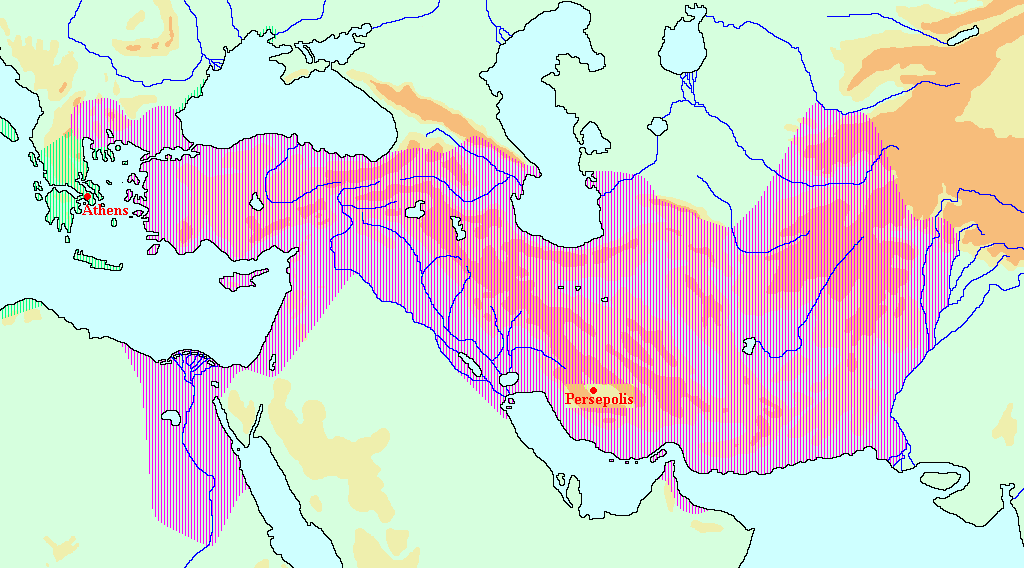
Also a small point that struck me in the book when they were discussing the Alexandrine Empire is the fact that they seem to be under the impression that no one on earth at that time could have administrated the sheer landmass of the Empire. It should be noted that 14 generations of Achaemenid rulers, had absolutely no problem ruling the Empire, and expanding it, to become the greatest empire in the world up to that point. Alexander on the other hand, did not just fail to completely conquer, losing out the provinces of Armenia and the Caucasus but managed with his death to destroy, and carve up. In truth Alexander was a figure very much like Alaric, the Goth, who destroyed the Western Roman Empire, with the exception that Alexander actually managed to gut an entire empire, whereas Alaric left half of it.
Last but not least concerning the chapter on the actual making of silk itself. I am always struck at the sheer ingenuity of ancient man, I don't know how many generations it took for someone to consider that the webs that bugs weave can be painstakingly collected, to form somehow, into perfectly straight lines in order to fashion clothing out of them. Where they would have found the inspiration to do these things or what there motivation might have been. Besides even that I am always fascinated by the fact that a huge trading empire existed stretching all the way back through human history, to a time, before even the bronze age, long before anyone knew what was on the other side, connecting the 2 greatest empires in early history.